Skip to product information
1 of 8

Nettelhorst Elementary School

Food Science: Food Science Fun

Food Science: Food Science Fun

  • For Grades K-2
  • Fridays from to at 3:30 PM to 4:30 PM
  • No Class Dates: 11/28/2025

In Food Science Fun, young learners become explorers of the everyday science all around them!

Through hands-on experiments and playful investigations, students discover how food connects to energy, health, and the natural world. They’ll test, sort, and observe how everyday items change, move, and react, all while building curiosity and confidence. Parents will love how this course turns science into an exciting adventure that inspires wonder, teamwork, and creativity.

Regular price $153.00
Regular price Sale price $153.00
Sale Sold out
Shipping calculated at checkout.
View full details
  • About Food Science: Food Science Fun

    Food Science Fun is aligned with the Next Generation Science Standards (NGSS) to ensure each activity builds real-world science skills. Students investigate states of matter (2-PS1-1), explore how heating and cooling changes materials (2-PS1-4), and practice observation and classification skills (K-LS1-1). By conducting investigations and recording what they see, students engage in Science and Engineering Practices such as asking questions, testing ideas, and sharing explanations. This focus area transforms everyday objects and experiences into powerful lessons in science and problem-solving.

  • Focus Areas

    In this focus area, students will explore exciting science topics using food as a lens for discovery. They’ll learn about energy and fuel, investigate solids, liquids, and gases, and test how temperature changes materials. Kids will also explore classification by sorting fruits and vegetables, practice observation with their five senses, and investigate density with sink-or-float activities. From mapping food origins to experimenting with mixtures, each topic helps students connect science concepts to the world they see every day.

  • Scientific Understanding of Food

    Students develop a foundational understanding of how heat, cooling, and mixing change food properties. They explore real-world science through cooking experiments that connect chemistry, energy, and nutrition.

  • Healthy Eating and Nutrition Awareness

    Through interactive activities, students learn to identify food groups, understand nutrients, and make balanced meal choices. They build awareness of how nutrition fuels the body and supports lifelong wellness.

  • Culinary Creativity and Entrepreneurship

    Students apply their knowledge by stepping into the chef’s role creating menus, planning meals, and simulating real-world restaurant experiences. They practice teamwork, creativity, and communication while building leadership skills.

Sample Lessons

These lessons introduce students to the fascinating world of food science through creativity and exploration. From discovering how food fuels our bodies to experimenting with states of matter and mapping farm-to-table journeys, each class blends science with fun. Students build, taste, and create while learning how everyday foods connect to energy, chemistry, and healthy living.

Collapsible content

Class 1 – Discover Food as Fuel + Create a Superhero Trading Card

Students kick off the week by learning how food gives our bodies energy, just like fuel powers a superhero! They’ll create fun trading cards that show off their healthy “superpowers.”

Class 2 – Explore States of Matter + Make Solid, Liquid, and Melted Snacks

Students experiment with how foods change state solid, liquid, or melted by exploring snack-based science. They’ll make tasty creations while discovering the chemistry of temperature and texture.

Class 3 – Learn Heating & Cooling + Design a “Frosty Banana” Comic

Students explore how heat and cold affect foods through fun experiments, then illustrate what happens in a comic story starring their very own “Frosty Banana” hero!

Class 4 – Explore Food Origins + Build a Farm-to-Table Map

Students trace how food travels from farms to their plates by building a colorful map that shows the journey of fruits, vegetables, and grains from harvest to home.

Class 5 – Sort Fruits vs. Vegetables + Classify With Clay Models

Students wrap up the week by identifying and classifying fruits and vegetables. Using clay, they’ll sculpt realistic food models to show what they’ve learned about plant parts and nutrition.


Course Format

Our Food Science Innovators curriculum blends the creativity of afterschool learning with the proven 5E instructional model Engage, Explore, Explain, Elaborate, and Evaluate. Each phase is designed to spark curiosity, build critical thinking, and make scientific discovery both fun and delicious!

Engage Phase: Students begin with thought-provoking questions, visuals, and food-based demonstrations that capture their imagination and connect science to everyday snacks.

Explore Phase: Learners conduct simple experiments to explore food properties, such as observing changes in texture, temperature, and state while handling real ingredients.

Explain Phase: Foundational science concepts like nutrition, energy, matter, and the chemistry of cooking are introduced in a way that bridges science with daily life.

Elaborate Phase: Students apply their learning through creative projects such as designing food comics, mapping food journeys, or building edible models that reinforce key concepts.

Evaluate Phase: Reflection and discussion allow students to share their findings, evaluate outcomes, and connect their scientific observations to healthy habits and sustainability.

This structured yet flexible approach ensures every student gains a meaningful understanding of food, science, and creativity empowering them to see everyday meals through a scientific lens.

Our Instructors Are Our Top Asset

At BAM!, our vision for innovative K-8 education extends beyond just curriculum; it encompasses the educators who bring that curriculum to life. Selecting & training our educators is a continuous and meticulous process, ensuring they are not just equipped with subject matter expertise but also the skills to inspire and connect with students on a personal level.

  • 100% adult educators recruited from prestigious universities ( No CITs at BAM!)
  • Highly refined interview and background check process 
  • Extensive training that goes well beyond curriculum & classroom management
  • Ongoing year-round opportunities to teach in our summer camp. After-school, and structured recess programs.
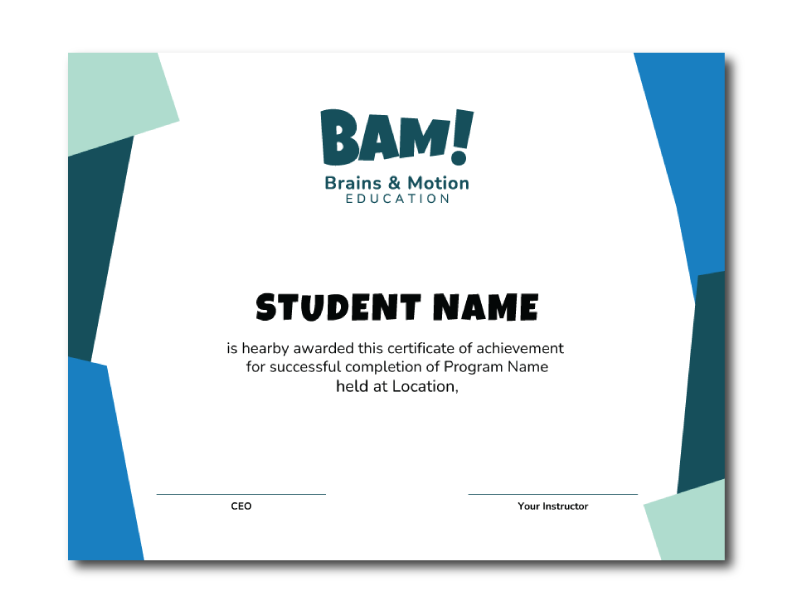
We celebrate your success!

Upon the conclusion of your child's program, they will be presented with an official Brains & Motion Education certification.